


Important: The Kraken is not an attorney, and the information in this post does not, and is not intended to, constitute legal advice. The content of this post is for general informational purposes only, and it may not include the most up-to-date legal or other information. Kraken Kratom hopes that you verify information through your own research and that you consult federal, state, and local laws and regulations for more information about Kratom’s legal status.
The kratom legal landscape has shifted faster in the past year than at any point in its history. New bans, the first-ever ban reversal, a wave of 7-OH actions, and a stack of pending bills have all landed in 2025 and 2026. We built this guide as a single page you can bookmark and return to: an interactive map, a searchable state table, a timeline of what changed, and the context behind it.
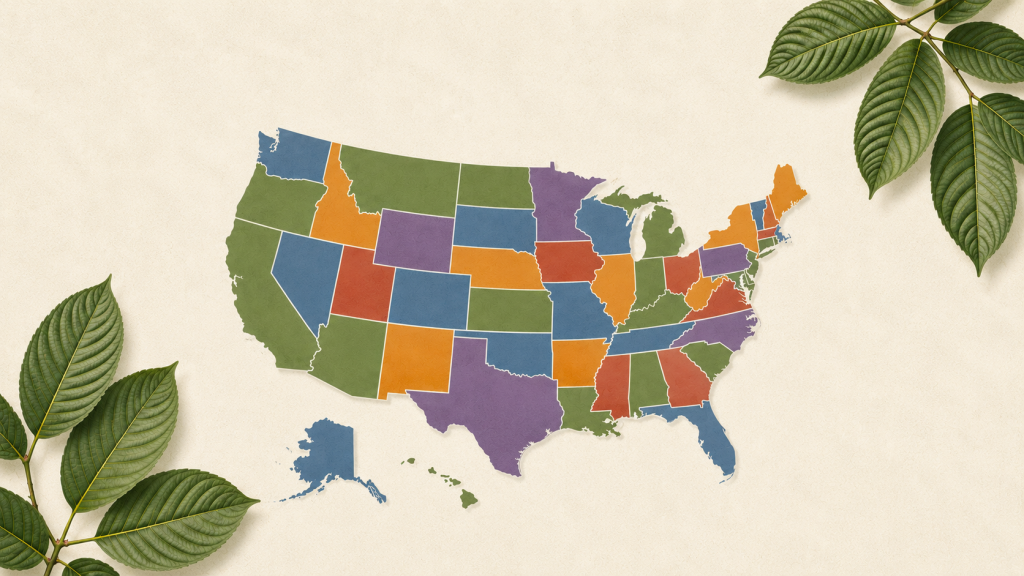
Kratom Legality in 2026
Hover, tap, or use your keyboard to focus any state and see its current status and recent developments. Use the filter buttons to highlight a single category.
📍 Hover, tap, or focus a state to see its kratom legal status and recent developments.
Kratom Legal Status by State
- Alabama — Banned: Banned since 2016. Alkaloids classified Schedule I.
- Alaska — Legal (No Specific Law): No statewide law. Proposed Anchorage ban pending.
- Arizona — Legal & Regulated (KCPA): KCPA in effect. (Age 18+)
- Arkansas — Banned: Full statewide prohibition.
- California — Legal (No Specific Law): No statewide kratom law. Local bans in San Diego, Oceanside & Newport Beach; CDPH retail enforcement active.
- Colorado — Legal & Regulated (KCPA): KCPA. Denver has a local ban. Synthetic 7-OH prohibited. (Age 18+)
- Connecticut — Banned: Schedule I designation (HB6855). Enforcement began Feb 2026.
- Delaware — Legal (No Specific Law): No specific restrictions.
- Florida — Restricted / Partial: Legal statewide except Sarasota County ban. Concentrated 7-OH products restricted.
- Georgia — Legal & Regulated (KCPA): KCPA. Age raised to 21+ in Jan 2025. (Age 21+)
- Hawaii — Pending Major Legislation: Currently legal. Ban legislation under consideration.
- Idaho — Legal (No Specific Law): Legal. KCPA bill (SB 1282) stalled in committee.
- Illinois — Legal & Regulated (KCPA): KCPA in effect. (Age 18+)
- Indiana — Banned: Banned since 2014.
- Iowa — Pending Major Legislation: Currently legal. SF 2013 proposes Schedule I classification. (Age 18+)
- Kansas — Banned: Schedule I ban (HB 2365). 7-OH scheduled with no threshold, so all kratom is banned. Effective July 1, 2026.
- Kentucky — Legal & Regulated (KCPA): Legal with KCPA-style regulation.
- Louisiana — Banned: Ban effective Aug 2025 (SB 154). Penalties up to 5 years. We cannot ship here.
- Maine — Legal (No Specific Law): No statewide restrictions.
- Maryland — Legal & Regulated (KCPA): KCPA passed and signed 2024.
- Massachusetts — Pending Major Legislation: Currently legal. Competing KCPA & ban bills filed 2025.
- Michigan — Pending Major Legislation: Currently legal. HB 5537 would prohibit kratom.
- Minnesota — Legal & Regulated (KCPA): Legal 18+. KCPA review pending. (Age 18+)
- Mississippi — Legal & Regulated (KCPA): KCPA (HB1077) effective Jul 2025. Bans synthetic 7-OH. (Age 21+)
- Missouri — Legal (No Specific Law): Legal. Regulations under review.
- Montana — Legal (No Specific Law): No specific regulation.
- Nebraska — Legal (No Specific Law): No specific regulation.
- Nevada — Legal & Regulated (KCPA): KCPA passed.
- New Hampshire — Legal (No Specific Law): Legal 18+. Some local variations. (Age 18+)
- New Jersey — Legal (No Specific Law): No specific kratom regulation.
- New Mexico — Legal (No Specific Law): No specific regulation.
- New York — Legal & Regulated (KCPA): 21+ sales restriction implemented 2025. (Age 21+)
- North Carolina — Legal (No Specific Law): Legal. 18+ age practice widely followed. (Age 18+)
- North Dakota — Legal (No Specific Law): No specific regulation.
- Ohio — Restricted / Partial: Emergency rule (Dec 2025) bans most products except pure mitragynine.
- Oklahoma — Legal & Regulated (KCPA): KCPA regulation established.
- Oregon — Legal & Regulated (KCPA): 21+ age requirement. Kratom must be disclosed as an ingredient. (Age 21+)
- Pennsylvania — Legal (No Specific Law): No specific kratom regulation.
- Rhode Island — Legal & Regulated (KCPA): Ban REVERSED — regulated framework live as of Apr 1, 2026 (first state to reverse a ban). (Age 21+)
- South Carolina — Legal & Regulated (KCPA): KCPA signed May 2025. Locked display cases required.
- South Dakota — Legal (No Specific Law): Legal 21+. Ban attempt failed Jan 2026. (Age 21+)
- Tennessee — Banned: NEW BAN — “Matthew Davenport’s Law” (HB1649) signed; full ban effective July 1, 2026.
- Texas — Legal (No Specific Law): Legal. HSC Ch. 444 caps 7-OH at 2% of alkaloids and bans synthetic alkaloids. Bills pending.
- Utah — Legal & Regulated (KCPA): KCPA in place. SB 45 amended — plain leaf remains legal.
- Vermont — Banned: Complete statewide ban.
- Virginia — Legal & Regulated (KCPA): KCPA passed 2023.
- Washington — Restricted / Partial: Legal except the Spokane city ban (Mar 2026). 95% excise tax proposed.
- West Virginia — Legal & Regulated (KCPA): KCPA passed 2023.
- Wisconsin — Banned: Statewide prohibition.
- Wyoming — Legal (No Specific Law): No specific regulation. Ban attempt defeated 2026.
- Washington D.C. — Banned: Banned. Treated as a Schedule I substance.
By the Numbers: 2026 Snapshot
What Changed in 2025–2026: A Timeline
A quick look at the most consequential developments of the past year. Green marks wins for kratom access, red marks new bans or restrictions, and orange marks mixed or pending action.
What’s Happening with 7-OH?
The biggest story of 2025–2026 has been the wave of action around 7-hydroxymitragynine (7-OH) — and in July 2026, it reached the federal level. Here’s where things stand:
One precision worth noting: the federal action isn’t limited to lab-synthesized 7-OH. It also covers kratom-derived products that were processed — chemically, thermally, or otherwise — in ways that push 7-OH past the threshold. What it protects is the natural leaf, where 7-OH occurs only in trace amounts, far below the line.
Where Kraken Stands: Below the Line, On Every Batch
Kraken Kratom has never sold concentrated or synthetic 7-OH products. Every product in our catalog is natural leaf–derived and tests below the federal threshold, verified on each batch’s certificate of analysis. Many states moved on 7-OH before the DEA did — Louisiana, Connecticut, Mississippi, Colorado, Florida, Ohio, Tennessee, Texas, and South Carolina have all restricted or banned 7-OH products in some form, though in several of these, natural kratom’s status differs from the 7-OH rules.
For the full breakdown of the DEA action — what’s covered, what isn’t, and how to read a COA — see our post: DEA Schedules 7-OH: What It Means for Natural Kratom.
We update this map as new legislation passes and the landscape evolves, so check back so you never miss a change in your state. For the latest kratom news and guides, visit the Kraken Kratom blog.
Shop Lab-Tested Natural Kratom
Every Kraken batch is made from natural Kratom leaf, GMP-compliant, and third-party lab-tested, with the certificate of analysis available before you buy.
Shop Kraken Kratom Online