Important: The Kraken is not an attorney, and the information in this post does not, and is not intended to, constitute legal advice. The content of this post is for general informational purposes only, and it may not include the most up-to-date legal or other information. Kraken Kratom hopes that you verify information through your own research and that you consult federal, state, and local laws and regulations for more information about Kratom’s legal status.
The kratom legal landscape has shifted faster in the past year than at any point in its history. New bans, the first-ever ban reversal, a wave of 7-OH actions, and a stack of pending bills have all landed in 2025 and 2026. We built this guide as a single page you can bookmark and return to: an interactive map, a searchable state table, a timeline of what changed, and the context behind it.
⚠️ Disclaimer: This map is for general information only and is not legal advice. Laws change frequently — always verify your local and state regulations before purchasing. For specific legal questions, consult a qualified attorney in your state.
Kratom Legality in 2026
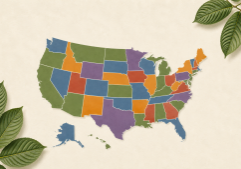
Hover, tap, or use your keyboard to focus any state and see its current status and recent developments. Use the filter buttons to highlight a single category.
Legal & Regulated (KCPA)Legal (No Specific Law)Restricted / PartialBannedPending Major Legislation
Filter by status
📍 Hover, tap, or focus a state to see its kratom legal status and recent developments.
⚠️ Reminder: This map is updated periodically but may not reflect the very latest change in every jurisdiction. Always check your state and local laws before purchasing. This is not legal advice. Kraken Kratom products are not intended to diagnose, treat, cure, or prevent any disease and have not been evaluated by the FDA. You must be 21 or older to purchase.
By the Numbers: 2026 Snapshot
17States with KCPA or similar regulation
17States legal with no specific law
9States with full bans (plus D.C.)
3States with partial restrictions
4States with major pending bills
What Changed in 2025–2026: A Timeline
A quick look at the most consequential developments of the past year. Green marks wins for kratom access, red marks new bans or restrictions, and orange marks mixed or pending action.
March 2025
Mississippi Passes HB1077 (KCPA)
Mississippi adopted the Kratom Consumer Protection Act, setting a 21+ age requirement and banning synthetic 7-OH concentrates while keeping natural kratom accessible to adults.
May 2025
South Carolina Signs KCPA Into Law
South Carolina’s KCPA took effect, requiring locked display cases and setting limits on synthetic alkaloid content — a model for responsible regulation.
June 2025
Connecticut Signs HB6855
Connecticut designated kratom and its derivatives, including 7-OH, as Schedule I substances. Enforcement began in February 2026.
July 2025
Rhode Island Reverses Its Ban 🎉
In a historic first, Rhode Island passed legislation to reverse its kratom ban and move to a regulated framework — the first state ever to reverse a kratom prohibition.
July 2025
HHS Issues 7-OH Scheduling Recommendation
Federal health officials recommended scheduling synthetic 7-hydroxymitragynine. This targets synthetic derivatives — not natural kratom products.
August 2025
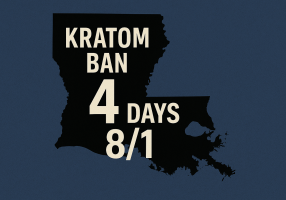
Louisiana Ban Takes Effect
Louisiana’s SB 154 went into effect, making it the 6th state to fully prohibit kratom, with penalties up to 5 years. Kraken Kratom can no longer ship to Louisiana.
December 2025
Ohio Issues Emergency Kratom Rule
Ohio’s Board of Pharmacy issued an emergency rule banning most kratom products except those composed solely of pure mitragynine.
March 2026
Spokane, WA Enacts City-Level Ban
Spokane enacted a local ban on kratom sales — a reminder that even in legal states, local jurisdictions can impose their own restrictions.
April 1, 2026
Rhode Island’s Regulated Framework Goes Live
The Rhode Island Kratom Act took effect, formally moving the state from prohibition to a KCPA-style regulated market for adults 21+.
July, 2026
Tennessee Bans Kratom — 8th State
Tennessee’s full statewide ban takes effect — covering natural leaf, powder, capsules, and extracts — making it the 8th state to fully ban kratom. The law, “Matthew Davenport’s Law” (HB1649), was signed by Gov. Bill Lee in April 2026.
July, 2026
Kansas Bans Kratom — 9th State
Kansas’s ban takes effect, making it the 9th state to fully ban kratom. Signed by Gov. Laura Kelly in April 2026, HB 2365 adds 7-OH and kratom-related substances to Schedule I — and because 7-OH occurs naturally in all kratom leaf with no concentration threshold, it prohibits every kratom product.
July, 2026
DEA Moves to Schedule 7-OH — Natural Kratom Explicitly Excluded
The DEA announced its intent to temporarily place 7-hydroxymitragynine above a specified concentration threshold into Schedule I (Docket No. DEA-1570), acting on the 2025 HHS recommendation. The action targets concentrated, synthetic, and chemically converted 7-OH products — natural kratom leaf, where 7-OH occurs only in trace amounts, falls below the threshold by definition. The notice publishes in the Federal Register July 6; the temporary order can take effect on or after August 5 and lasts up to two years. The American Kratom Association supported the action.
What’s Happening with 7-OH?
The biggest story of 2025–2026 has been the wave of action around 7-hydroxymitragynine (7-OH) — and in July 2026, it reached the federal level. Here’s where things stand:
✅ Federal status of natural Kratom: Natural kratom leaf remains unscheduled and legal at the federal level. Nothing in the 2026 DEA action changes that.
⚖️ Federal status of concentrated 7-OH: On July 1, 2026, the DEA announced its intent to temporarily place 7-OH above a specified threshold into Schedule I of the Controlled Substances Act. The threshold is a measurable lab value: botanical material over 0.05% 7-OH by dry weight, or synthetic and chemically/thermally converted products over 0.05% — or over 1.00 mg of 7-OH per article. Related forms (isomers, esters, ethers, salts) and the semi-synthetic derivatives MP, MGM-15, and MGM-16 are included. The order can take effect on or after August 5, 2026, lasts up to two years, and can be extended by one year.
One precision worth noting: the federal action isn’t limited to lab-synthesized 7-OH. It also covers kratom-derived products that were processed — chemically, thermally, or otherwise — in ways that push 7-OH past the threshold. What it protects is the natural leaf, where 7-OH occurs only in trace amounts, far below the line.
Where Kraken Stands: Below the Line, On Every Batch
Kraken Kratom has never sold concentrated or synthetic 7-OH products. Every product in our catalog is natural leaf–derived and tests below the federal threshold, verified on each batch’s certificate of analysis. Many states moved on 7-OH before the DEA did — Louisiana, Connecticut, Mississippi, Colorado, Florida, Ohio, Tennessee, Texas, and South Carolina have all restricted or banned 7-OH products in some form, though in several of these, natural kratom’s status differs from the 7-OH rules.
For the full breakdown of the DEA action — what’s covered, what isn’t, and how to read a COA — see our post: DEA Schedules 7-OH: What It Means for Natural Kratom.
We update this map as new legislation passes and the landscape evolves, so check back so you never miss a change in your state. For the latest kratom news and guides, visit the Kraken Kratom blog.
Legal where you live? You’re set.
Shop Lab-Tested Natural Kratom
Every Kraken batch is made from natural Kratom leaf, GMP-compliant, and third-party lab-tested, with the certificate of analysis available before you buy.