
legislation

On July 1, 2026, the DEA announced its intent to place 7-hydroxymitragynine — 7-OH — above a specific concentration threshold into Schedule I of the Controlled Substances Act. If you’ve seen the concentrated 7-OH gummies, tablets, and shots sold as “kratom” at gas stations and smoke shops, those are the products this action targets. Natural kratom leaf is not covered — and that distinction is written directly into the rule as a measurable lab threshold.
For Kraken customers, nothing changes. Every product in our catalog starts as natural kratom leaf, tests below the scheduled 7-OH threshold, and ships with a per-batch certificate of analysis to prove it. Here’s what the action actually says, what’s covered and what isn’t, and why the federal government just drew the same line we’ve built our catalog around since 2014.
Read More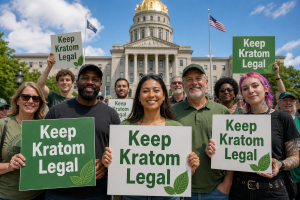
State legislative sessions are wrapping up across the country, but the fight for safe, legal kratom access is far from over. Right now, three states — South Carolina, California, and Michigan — are facing critical decisions that could strip access from thousands of responsible adult consumers.
We’re asking the Kraken Kratom community to step up. Here’s exactly what’s happening, why it matters, and how you can make your voice heard in the next few days.
Why This Moment Matters
Kratom prohibition doesn’t make communities safer. It pushes responsible adults toward unregulated markets, eliminates quality controls, and ignores the millions of Americans who use kratom responsibly every day.
Read More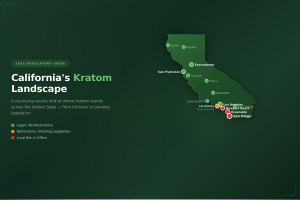
California is one of the largest Kratom markets in the country — nearly 40 million residents call it home. But the state’s regulatory landscape has become a patchwork of state guidelines, local bans, and new enforcement actions that every Kratom consumer needs to understand.
Here’s a clear breakdown of where things stand right now.
State-Level Status: Legal, But It’s Complicated
At the state level, Kratom remains legal for adults 18 and over. However, California hasn’t passed comprehensive Kratom Consumer Protection Act (KCPA) legislation, leaving it in what many describe as a regulatory gray area.
Read More
In a last-minute move that has stunned Kratom advocates and consumers, Connecticut lawmakers have added a sweeping amendment to House Bill 6855 — originally intended to regulate hemp — that could effectively ban Kratom across the state. The bill, with the Kratom provision added just days before the end of the legislative session, has now passed both chambers and awaits Governor Ned Lamont’s signature.
If signed into law, HB6855 would classify all types of Kratom as a controlled substance, giving state officials the authority to place it in any schedule they deem appropriate. That means Kratom could be lumped in with Schedule I substances — like LSD or heroin — despite its long history of traditional use and low potential for harm. Even if it’s placed in a lower schedule, the result is essentially the same: a ban on access for Connecticut consumers.
Read More
LB230 is a bill aimed at regulating Kratom in Nebraska by setting safety standards, requiring clear labeling, and implementing age restrictions for buyers. While that might sound scary at first, it’s actually a step toward ensuring consumer safety and keeping Kratom legal for responsible adults. The bill outlines a framework for quality control, proper labeling, and age restrictions, which are all things we support to help build a safer, more transparent industry.
LB230 is a bill aimed at regulating Kratom in Nebraska by setting safety standards, requiring clear labeling, and implementing age restrictions for buyers. While that might sound scary at first, it’s actually a step toward ensuring consumer safety and keeping Kratom legal for responsible adults. The bill outlines a framework for quality control, proper labeling, and age restrictions, which are all things we support to help build a safer, more transparent industry.
Read More
Kratom advocacy is one of the most important things that we support here at Kraken Kratom, and we realize just how much many aspects of the kratom advocacy movement have been changing in recent months. What can be done to ensure that kratom advocacy can effectively continue as the pandemic continues to be handled? Let’s talk about it.
Read More